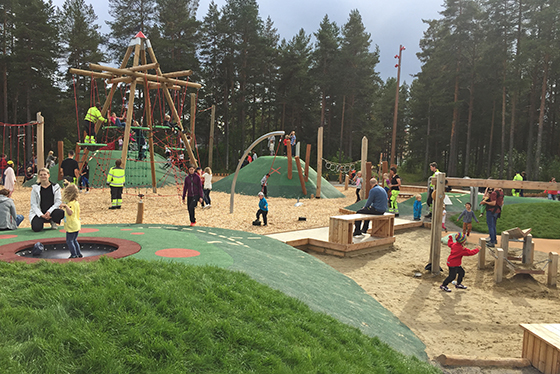
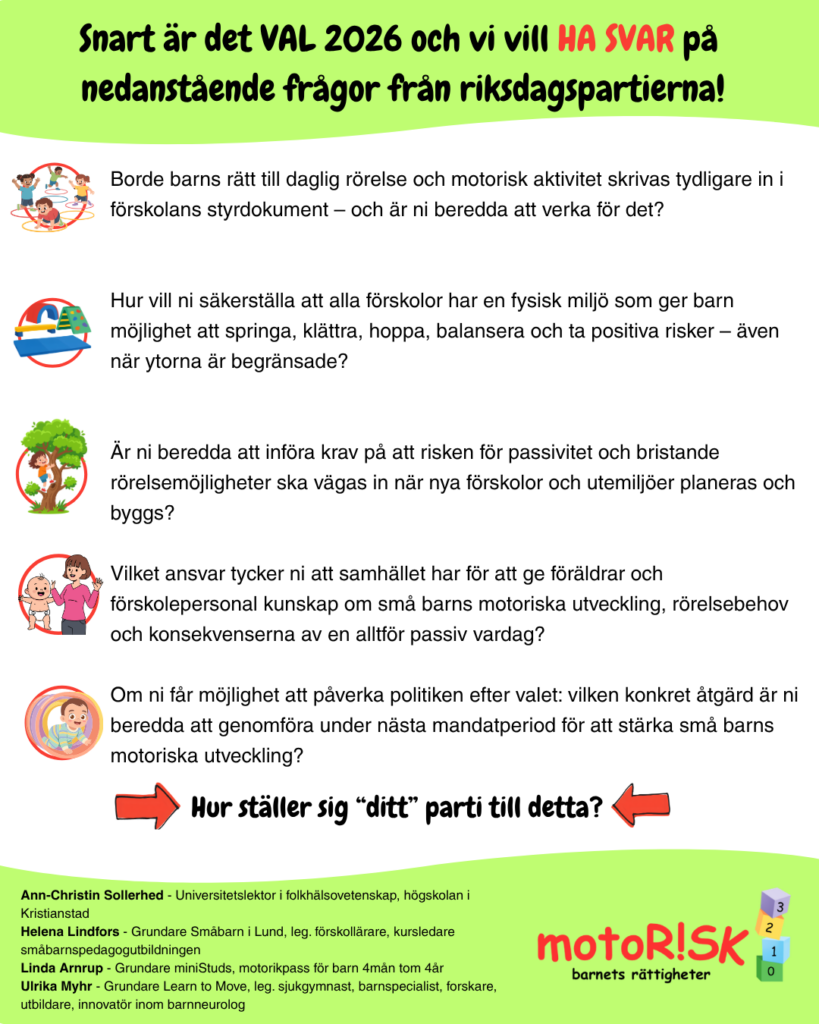
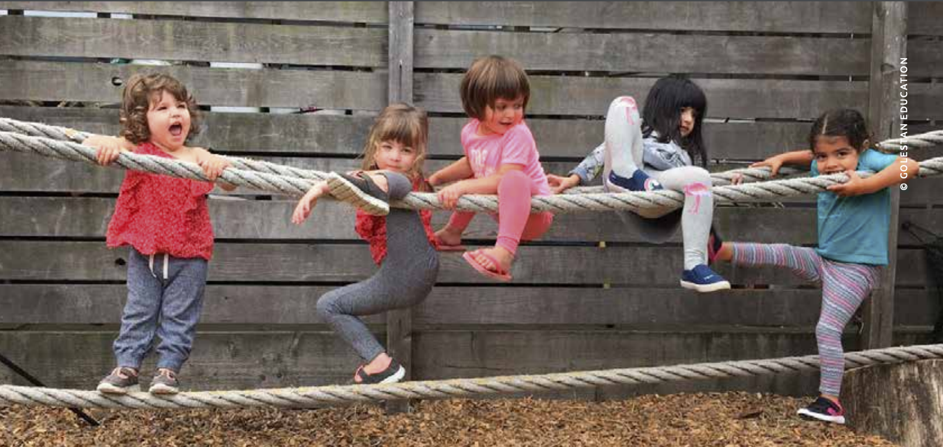
With an election approaching, the Motorisk group — where Learn to Move collaborates with researchers and professionals working with children’s motor development in preschool — wants to highlight the importance of creating good environments for movement and physical development in preschools. Children need space to run and move, opportunities to take appropriate risks, and environments that allow them to challenge themselves physically. There is a great need for this. If you would like to raise these issues with your local or national politicians, please feel free to share them. In well-designed environments, children become active and independent — they play, explore and learn. In poor environments, passivity is allowed to flourish.
So far, the Motor Development for Preschools course has been held twice. It has been incredibly rewarding, and the evaluations clearly show that there is a great need for this kind of training. One of the aims is to increase understanding of the important role preschools play today in helping children grow into strong, happy and confident individuals. So much happens during the preschool years that lays the foundation for a child’s self-image and self-esteem. Children need challenges to solve. They also need opportunities to take risks, test their limits and sometimes fail. Preschool teachers need the knowledge and confidence to explain to parents why this matters — and how avoiding one risk may create another. If children are never allowed to test their limits, we may instead increase the risk of passivity, poorer mental well-being and a lack of confidence in their own physical abilities. Creating play environments that meet children’s developmental needs at different ages is fundamental. When the environment provides the right opportunities and challenges, children can become increasingly independent in their play, movement and exploration. The next course will be held on 24 April.
In recent weeks, both newspapers and TV news have highlighted that children’s motor skills have declined – that they can’t use scissors or do somersaults like before. The decline begins already in the newborn stage because children´s motor skills develop better in the prone position, and tummy time is often lacking. In prone, one learns how to understand how to lift the body up from having floated weightlessly in the womb before birth. Understanding, problem-solving, and motor skills are interconnected – the brain develops less if motor skills deteriorate. We need to understand this and implement measures so that all children can feel good both physically and mentally. Here is a contributiont to the debate from Learn to Move.
The motor development of the very youngest is extremely important for the overall development of the child. Motor skills influence cognition and attention. Now, Expo Medica’s full day on motor development is returning. The course takes place in Stockholm on November 30th. At this full-day training, you will learn about current issues and how to support children and parents for a positive development. The newborn period up to 3 months is crucial for a good start and avoiding common issues. The course discusses, for example, WHY tummy time is so important, when it should be initiated, and when head control should be fully programmed.
Along with Ann-Christine Sollerhed, Helena Lindfors, and Linda Arnrup, Learn to Move is highlighting the need for structural changes in preschool policy documents, knowledge among manufacturers of children’s products and environments, and significantly more control and knowledge during the child’s first years of life to ensure that the child learns basic reflexes and movement prerequisites, which in turn lead to good motor development. Strong measures are needed to reverse the trend where Sweden lags far behind its Nordic neighbors. Here is a link to the opinion piece from Svenska Dagbladet
Vi använder cookies för att se till att vi ger dig den bästa upplevelsen på vår webbplats. Om du fortsätter att använda denna webbplats kommer vi att anta att du godkänner detta.